15 June 2011

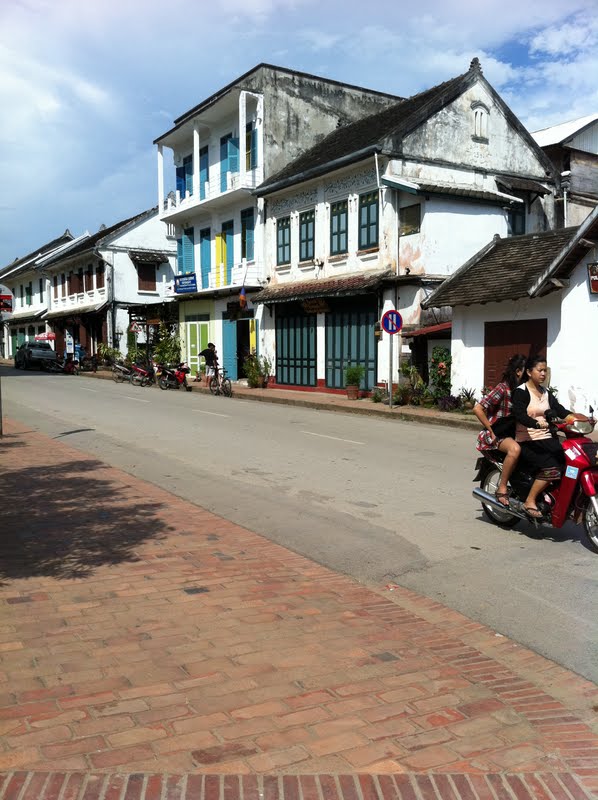
Luang Prabang is another Unesco World Heritage site. (There do seem to be a lot of them.)


The heat and humidity are oppressive and you quickly find yourself slowing down and assuming some of the gentleness of the people who live here. Luang Prabang is a tiny town with over 33 Wats (Temples). Something of that sense of mysticism or reverence is palpable as you walk (slowly) through town or hire one of the local yak yaks to take you to your destination. Each temple is unique. Some have been handsomely refurbished by locals who have made it big elsewhere and then come home to endow a temple to ensure good karma. Others show their years with a sad air of neglect.


Our hotel, the Mekong Riverview Hotel, was wonderful. The Swedish owner, Urban Paulsson, hosted a wine aperitivo where he explained his philosophy in running the hotel. Many of his workers are former Monks. All the workers are paid a decent wage and must pay local taxes, as does the hotel - something which, apparently, not many people or businesses do. To avoid paying the graft which is a necessary part of doing business in the town, Urban takes on local projects. For instance, he paid to have street lights installed on the riverside street where the hotel is located and furnished a local village with electricity. He has empowered his employees to think for themselves and act accordingly. As a result, his wonderful staff seemed to anticipate our every desire. Going to visit the waterfall? As we congregated in the lobby, we were each given a plastic bag containing towels. Joan, Sanjay and Irwin throwing a cocktail party on our boat trip on the Mekong? The staff supplied a cooler with ice ... and carried it to the boat for us. They then stood on the steps and waved us off. The air conditioned rooms were beautifully constructed of local woods, the showers wonderful but the very best part was ... the beds. These were Swedish twin beds with a tempurpedic style mattress covered with a pad made of angel down. A remote raised the head or foot to perfect relaxing/reading mode. If I'm wrong and there really is a heaven, I bet it's just like the Mekong Riverview Hotel!

Air conditioning. You never know just how much you need it until you no longer have it. Although our hotel rooms were air conditioned, not much else in the town was. Even cafes and restaurants seldom had the wonderful stuff. Unlike Hoi An, where there always seemed to be at least a bit of a breeze, here nothing but the odd fan stirred the thick air. And our hotel, perfect in all other ways, had no pool. They're not allowed in the World Heritage village.
Fortunately, there were excursions. We all trooped off to the waterfall and happily plunged into the refreshingly cold water.


On the way, we passed the Bear Rescue Center. These are bears that have been rescued by the Laos authorities from the illegal wildlife trade. Signs documented the horrific conditions these bears endure when they are used as living bile donors: the bile is used in traditional Asiatic medicines. Please take a moment and click on this purple Bear link. Once I read about the inspiring work done by the Free the Bears nonprofit, I sent them a donation and I hope you will, too. (Or buy some of their sweet merchandise.)
Joan, Jennifer and I took a tour to the Elephant Village, an elephant rescue center. When we first got there, I was incensed because I thought these "rescued" elephants were being exploited by being made to carry tourists on their backs. But, as I read more about the horrible conditions they faced in the logging industry, I soon changed my mind. The work there is hard and long (12 hour days with the elephants often given amphetamines to keep them going) and dangerous. As the logging industry is shutting down, these elephants are often set free in areas where population growth has denuded the forest and many starve to death. The rescued elephants work only 4 to 5 hours a day, have round the clock veterinary care, and get to sleep in the jungle at night.
Jennifer and Joan rode an elephant but I opted out, having very vivid memories of my photo op on a camel.

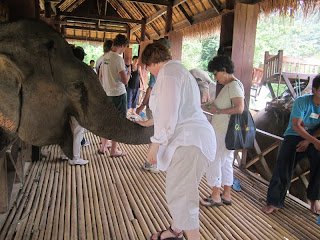
When my friends returned, we stood on a wooden platform to feed bananas to the elephants. When Jennifer tried to hand a banana to her elephant's trunk, her mahout (trainer) told her to put it directly in the elephant's mouth. I peeled off one banana and bent over to put it in my elephant's mouth. While I was thus occupied, she nimbly wrapped her trunk around the rest of the bunch and popped it into her mouth! The photos below show the act and my befuddlement. If you go to the Elephant Village website and check out the elephants, I'm sure mine was the one named "Buffet". Greedy wench!



Jennifer arranged a boat all to ourselves as we enjoyed a sunset cruise on the Mekong River, made all the more fun with the cocktail hour supplied by our friends. Luckily, this boat was captained by someone who managed to get us there and back, unlike our ill fated (but hysterical) sunset Nile cruise. Greg spotted some water buffalo on an island and he and Nic went off to photograph them while Jennifer and I discussed the need for additional life insurance.


What a fun and interesting bunch of companions I had in Luang Prabang! It was a chance to really get to know Jennifer (who I already knew) and Joan Singer (a new friend). Jennifer Davidson is the author of Stop Smelling My Rose! which I highly recommend and Joan manages and is part of a quintet called QuinTango. I've downloaded her album QuinTango Live! and plan to get her other album, as well. (you can get both at www.cdbaby.com or order CDs from her website.)
We were all in Luang Prabang at Jennifer's suggestion. Jennifer's father had been the UK ambassador to Laos when Jennifer was a young girl. He was presented to the king and dined in the Royal Palace in Luang Prabang. There, he befriended the king's cook. The result was the definitive volume of Laotian cooking which Jennifer edited for her father. Jennifer and I went together to the Royal Palace Museum (the king was deposed in the 1975 revolution). We rented one of those do it yourself tour tape recorders and each had our own headset. Thus hobbled together, we shuffled through the museum. When we got to the room where the king received diplomats, Jennifer marveled that her father had stood in that very room. When we stood looking into the dining room, Jennifer told me the story of her father and the cookbook. Then she hit the talk button. The narrater explained various bits about the room and then he began to tell the story of Jennifer's father and his cookbook. The hairs on the back of my neck rose and the look of incredulous wonder on Jennifer's face is something I shall always remember. I mean, really, how awesome is that! Daughters - the lucky ones - share a special bond with their fathers. I wear my dad's ring and sometimes, I admit, talk to it. I'd love to be able to trace his steps.

A trip to the morning market made me an instant vegetarian - a life change that did not survive lunch. Putting aside the images of fly covered raw meat, I had water buffalo carpaccio (thinly sliced raw buffalo) for dinner, which is probably the source of the bug that hitched a ride to Zurich in my gut. Bug or not, it was one of the best meals I had on the trip.


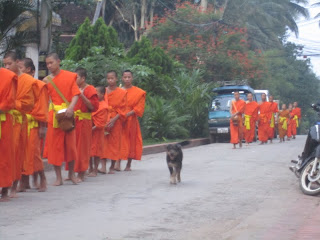
To see the morning procession of monks, one had to get up VERY early. Greg and I kept putting it off until close to the end of our stay. We set off in the early dawn silence, broken only by the loud self-publicising cries of "gecko". As we waited, men and women emerged from their homes and sat on low plastic stools by the side of the road, a pot of rice in their laps. Soon, out of the silence, the first group of monks ghosted silently past. The regalness of their progress was in no way diminished by the dog that led them. Tail up, head alert, he swaggered before them like a major domo. The monks parade once around the block and when this group returned, their leader was still pacing smartly in front.



On our final night in Loas, we shared one last supper. At the end, we took part in our usual ritual. Only this time it was kip instead of dong. I have no kip. I need more kip. I have extra kip - who wants my kip? I'm quite kippered. Somehow it was nowhere near as funny as when the currency was dong.


Luang Prabang is another Unesco World Heritage site. (There do seem to be a lot of them.)


The heat and humidity are oppressive and you quickly find yourself slowing down and assuming some of the gentleness of the people who live here. Luang Prabang is a tiny town with over 33 Wats (Temples). Something of that sense of mysticism or reverence is palpable as you walk (slowly) through town or hire one of the local yak yaks to take you to your destination. Each temple is unique. Some have been handsomely refurbished by locals who have made it big elsewhere and then come home to endow a temple to ensure good karma. Others show their years with a sad air of neglect.


 |
| This wat needs a wealthy sponsor. |
Our hotel, the Mekong Riverview Hotel, was wonderful. The Swedish owner, Urban Paulsson, hosted a wine aperitivo where he explained his philosophy in running the hotel. Many of his workers are former Monks. All the workers are paid a decent wage and must pay local taxes, as does the hotel - something which, apparently, not many people or businesses do. To avoid paying the graft which is a necessary part of doing business in the town, Urban takes on local projects. For instance, he paid to have street lights installed on the riverside street where the hotel is located and furnished a local village with electricity. He has empowered his employees to think for themselves and act accordingly. As a result, his wonderful staff seemed to anticipate our every desire. Going to visit the waterfall? As we congregated in the lobby, we were each given a plastic bag containing towels. Joan, Sanjay and Irwin throwing a cocktail party on our boat trip on the Mekong? The staff supplied a cooler with ice ... and carried it to the boat for us. They then stood on the steps and waved us off. The air conditioned rooms were beautifully constructed of local woods, the showers wonderful but the very best part was ... the beds. These were Swedish twin beds with a tempurpedic style mattress covered with a pad made of angel down. A remote raised the head or foot to perfect relaxing/reading mode. If I'm wrong and there really is a heaven, I bet it's just like the Mekong Riverview Hotel!
 |
| Nic at our hotel. |
Air conditioning. You never know just how much you need it until you no longer have it. Although our hotel rooms were air conditioned, not much else in the town was. Even cafes and restaurants seldom had the wonderful stuff. Unlike Hoi An, where there always seemed to be at least a bit of a breeze, here nothing but the odd fan stirred the thick air. And our hotel, perfect in all other ways, had no pool. They're not allowed in the World Heritage village.
Fortunately, there were excursions. We all trooped off to the waterfall and happily plunged into the refreshingly cold water.


On the way, we passed the Bear Rescue Center. These are bears that have been rescued by the Laos authorities from the illegal wildlife trade. Signs documented the horrific conditions these bears endure when they are used as living bile donors: the bile is used in traditional Asiatic medicines. Please take a moment and click on this purple Bear link. Once I read about the inspiring work done by the Free the Bears nonprofit, I sent them a donation and I hope you will, too. (Or buy some of their sweet merchandise.)
 |
| The bears had a wonderful large playground. I wanted to get right in there with them! |
Joan, Jennifer and I took a tour to the Elephant Village, an elephant rescue center. When we first got there, I was incensed because I thought these "rescued" elephants were being exploited by being made to carry tourists on their backs. But, as I read more about the horrible conditions they faced in the logging industry, I soon changed my mind. The work there is hard and long (12 hour days with the elephants often given amphetamines to keep them going) and dangerous. As the logging industry is shutting down, these elephants are often set free in areas where population growth has denuded the forest and many starve to death. The rescued elephants work only 4 to 5 hours a day, have round the clock veterinary care, and get to sleep in the jungle at night.
Jennifer and Joan rode an elephant but I opted out, having very vivid memories of my photo op on a camel.

When my friends returned, we stood on a wooden platform to feed bananas to the elephants. When Jennifer tried to hand a banana to her elephant's trunk, her mahout (trainer) told her to put it directly in the elephant's mouth. I peeled off one banana and bent over to put it in my elephant's mouth. While I was thus occupied, she nimbly wrapped her trunk around the rest of the bunch and popped it into her mouth! The photos below show the act and my befuddlement. If you go to the Elephant Village website and check out the elephants, I'm sure mine was the one named "Buffet". Greedy wench!


Jennifer arranged a boat all to ourselves as we enjoyed a sunset cruise on the Mekong River, made all the more fun with the cocktail hour supplied by our friends. Luckily, this boat was captained by someone who managed to get us there and back, unlike our ill fated (but hysterical) sunset Nile cruise. Greg spotted some water buffalo on an island and he and Nic went off to photograph them while Jennifer and I discussed the need for additional life insurance.
 |
| Our wonderful hotel staff returning up the long stairs after waving us off. |
 |
| Best cocktail party ever. |
 |
| Great white hunters. |
 |
| Hmmm. Does he look friendly? |


What a fun and interesting bunch of companions I had in Luang Prabang! It was a chance to really get to know Jennifer (who I already knew) and Joan Singer (a new friend). Jennifer Davidson is the author of Stop Smelling My Rose! which I highly recommend and Joan manages and is part of a quintet called QuinTango. I've downloaded her album QuinTango Live! and plan to get her other album, as well. (you can get both at www.cdbaby.com or order CDs from her website.)
We were all in Luang Prabang at Jennifer's suggestion. Jennifer's father had been the UK ambassador to Laos when Jennifer was a young girl. He was presented to the king and dined in the Royal Palace in Luang Prabang. There, he befriended the king's cook. The result was the definitive volume of Laotian cooking which Jennifer edited for her father. Jennifer and I went together to the Royal Palace Museum (the king was deposed in the 1975 revolution). We rented one of those do it yourself tour tape recorders and each had our own headset. Thus hobbled together, we shuffled through the museum. When we got to the room where the king received diplomats, Jennifer marveled that her father had stood in that very room. When we stood looking into the dining room, Jennifer told me the story of her father and the cookbook. Then she hit the talk button. The narrater explained various bits about the room and then he began to tell the story of Jennifer's father and his cookbook. The hairs on the back of my neck rose and the look of incredulous wonder on Jennifer's face is something I shall always remember. I mean, really, how awesome is that! Daughters - the lucky ones - share a special bond with their fathers. I wear my dad's ring and sometimes, I admit, talk to it. I'd love to be able to trace his steps.
 |
| Here Jennifer and I take a tuk tuk to the Royal Palace Museum. |

 |
| Jennifer and the museum curator. |
A trip to the morning market made me an instant vegetarian - a life change that did not survive lunch. Putting aside the images of fly covered raw meat, I had water buffalo carpaccio (thinly sliced raw buffalo) for dinner, which is probably the source of the bug that hitched a ride to Zurich in my gut. Bug or not, it was one of the best meals I had on the trip.
 |
| Roadkill anyone? |


 |
| Yum. Grubs. Still twitching energetically. |

 |
| Yup. Those are rats. |

To see the morning procession of monks, one had to get up VERY early. Greg and I kept putting it off until close to the end of our stay. We set off in the early dawn silence, broken only by the loud self-publicising cries of "gecko". As we waited, men and women emerged from their homes and sat on low plastic stools by the side of the road, a pot of rice in their laps. Soon, out of the silence, the first group of monks ghosted silently past. The regalness of their progress was in no way diminished by the dog that led them. Tail up, head alert, he swaggered before them like a major domo. The monks parade once around the block and when this group returned, their leader was still pacing smartly in front.


On our final night in Loas, we shared one last supper. At the end, we took part in our usual ritual. Only this time it was kip instead of dong. I have no kip. I need more kip. I have extra kip - who wants my kip? I'm quite kippered. Somehow it was nowhere near as funny as when the currency was dong.
 |
| Joan, Jennifer, Nic, me, Greg, Irwin |
 |
| I'll see your kip and raise you five dollars. |